
Kernel got a junior: Nothing Felt Minor
Sat Dec 20 2025
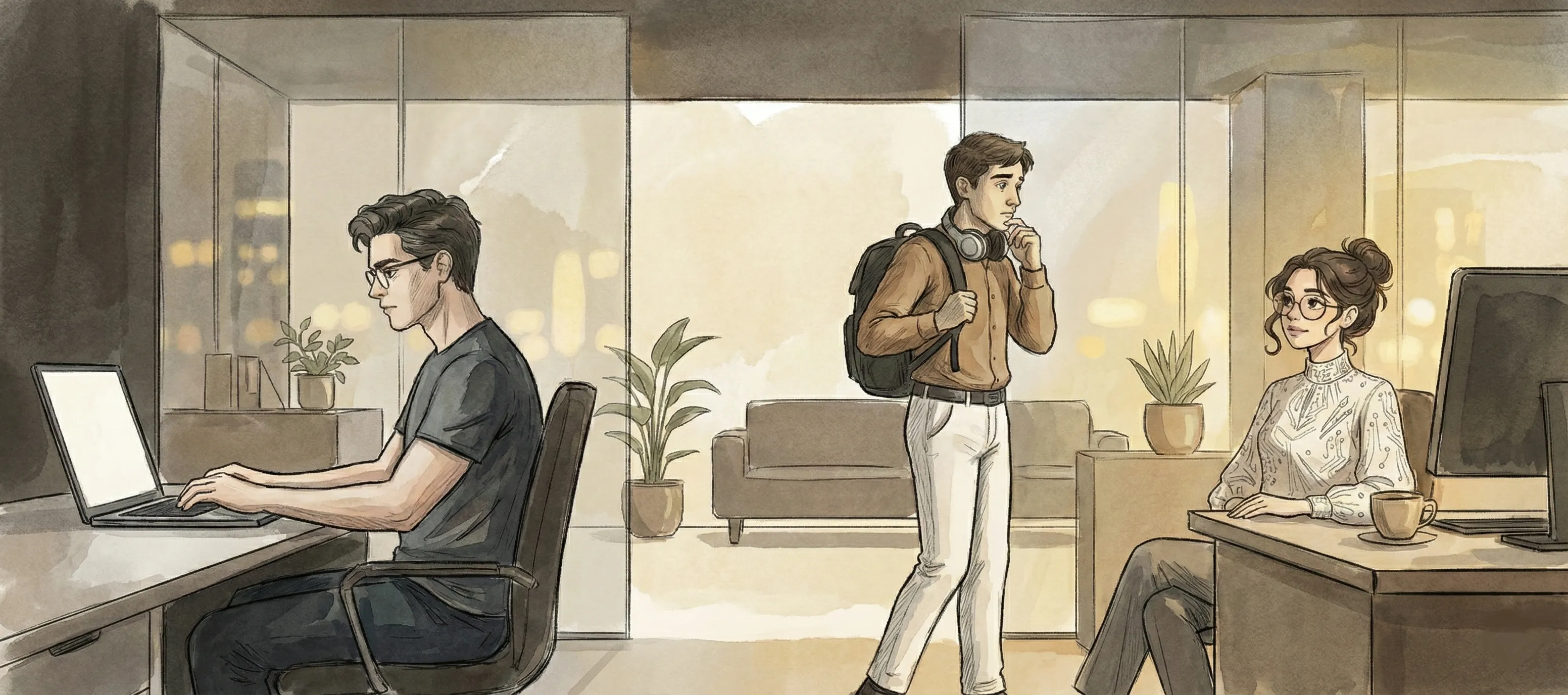
🍜 The lunch break
This was one of the office weeks.
I was already at the cafeteria table, watching a status notification fade on my phone, when Kernel walked in.
Same calm stride.
Same unreadable focus.
Except today, he had company.
He stopped beside the table, as if he’d almost forgotten something important, then stepped aside.
“Novi,” he said. “This is Flip.”
Flip smiled immediately. Too immediately.
“Hi. I’m Flip. I joined Kernel’s team this week.”
He nodded once. Then again, just to be safe.
“Sit,” I said, before he could choose the wrong option.
Kernel took his usual seat — back to the wall, facing outward, posture already in meeting mode.
Flip sat next to him.
Not across.
Not diagonally.
Next.
That told me enough.
Flip started talking. Freshers always do.
College. Interests. Excitement. The thrill of finally seeing real production code.
Kernel listened.
Didn’t interrupt.
Didn’t nod.
Didn’t confirm that reality, in fact, existed.
I helped.
“So,” I said, “first in-office week treating you well?”
Flip laughed. Fast.
“Yes! I mean — it’s great. There’s a lot to learn. Kernel’s codebase is… very disciplined.”
Kernel took a sip of water.
Disciplined, to him, was not praise.
It was the minimum.
Flip glanced at Kernel. Then back at me.
“I mean,” he said, lowering his voice, “even small changes feel… visible.”
Kernel said nothing.
I smiled. “That’s usually a good sign. It means the system is awake.”
Flip nodded. His shoulders stayed tense.
The silence wasn’t awkward.
It was observant.
Kernel broke it.
“Flip worked on a helper module this morning.”
Flip straightened.
“I fixed it,” he said quickly. “The issue. I mean. It was minor. I rolled it back. I just thought—”
“You shouldn’t have touched it yet.”
Kernel’s voice didn’t change.
Flip froze.
Not at the correction.
At the yet.
“You’ll get there,” Kernel added. “Just not today.”
That was all.
Kernel returned to his lunch.
Flip smiled. The muscles engaged. The confidence didn’t.
Kernel’s watch vibrated. He stood.
“Meeting,” he said. “Finish up.”
Then, almost casually, to Flip: “Next time, get it reviewed before pushing to main.”
And he was gone.
Flip watched him leave.
Didn’t speak for a moment.
Then, softly: “He’s… strict.”
Not angry.
Not accusing.
Just slightly compressed.
I stirred my coffee.
“He is.”
Flip exhaled. Relieved. “Right? I mean, it was a small change. Easy to roll back.”
I looked at him.
“At this stage,” I said, “small changes are allowed.”
Flip blinked. “Allowed?”
“Yes,” I said. “Just not everywhere.”
He frowned, like the question was forming — and then quietly archived itself.
It wasn’t really about the change.
It rarely is.
👀 Flip Finds Me
Flip found me the way juniors always do.
Not by asking.
By hovering.
I was refilling my coffee when he appeared at the counter, studying the sugar packets like they held architectural secrets.
“Hey,” he said. Casual. Too casual.
“Quick question.”
It never was.
“Sure,” I said. Coffee makes me generous.
He leaned in slightly. Not invading space. Just borrowing confidence.
“So… Kernel mentioned not pushing directly to main.”
I nodded. “He usually does.”
“Right. Obviously. Makes sense.” A pause.
“I was just wondering if there are… exceptions?”
There it was.
Not rebellion.
Negotiation.
I stirred my coffee. Let the silence work.
“Exceptions exist,” I said. “They announce themselves. Loudly. With consequences.”
Flip laughed. Polite.
Then quieter, “Yeah. That tracks.”
He didn’t leave.
Instead, he walked with me back to my desk.
That’s how I knew this wasn’t about Git.
After that, Flip started appearing.
Not dramatically.
Just… correctly timed.
If I was reviewing a PR, he’d be nearby.
If I was sketching in my notebook, he’d lean over.
“I like how you think about edge cases,” he said once.
Flattering.
Also wrong.
I mostly think about why things fail at 2 a.m.
One afternoon, he asked, “Does Kernel ever say ‘good job’?”
I didn’t answer.
I asked, “Did he correct your code today?”
“Twice.”
I smiled. “Then you’re fine.”
Flip didn’t smile back.
“In front of the seniors,” he added.
Ah.
I looked at him properly.
He wasn’t angry.
Just compressed.
Later, during a long build, he sat across from me.
Spun his chair. Stopped. Corrected the angle.
“I know he’s not wrong,” Flip said.
“I just thought I’d do better. Faster.”
“You will.”
“But—”
“I didn’t say but.”
He exhaled. “It just feels like it’s never enough.”
I kept my eyes on my screen.
“Kernel doesn’t measure effort,” I said.
“He measures impact.”
Flip frowned. “That’s worse.”
“Only if you’re collecting approval instead of skill.”
That landed.
Then, softer: “I don’t want to disappoint him.”
That one stuck.
I turned toward him.
“Kernel doesn’t waste disappointment on people he doesn’t care about.”
Flip blinked. “He cares?”
I shrugged. “He invests.”
Kernel walked past our row.
Didn’t stop.
Didn’t look.
Flip straightened instantly.
Kernel paused. Barely.
“Flip,” he said, without turning fully, “send the patch for review before EOD.”
“Yes,” Flip said.
Kernel left.
Flip sat back slowly.
”…See?” he said. “Strict.”
I took a sip of coffee.
“Consistent.”
Flip didn’t argue.
But he stayed.
And that again told me enough.
💥 Thursday — The Push
The mistake happened on a Thursday.
Thursdays are dangerous.
People feel efficient. Confidence inflates. Safeguards start looking optional.
Flip was working on a small fix. Genuinely small.
One function.
One file.
One line that looked so harmless it almost asked to be trusted.
He ran the tests.
Green. All of them.
He stared at the checks a little longer than necessary.
Then he skipped something.
Not because he didn’t know better.
Because he wanted to be fast.
He pushed.
Straight to main.
I noticed because the build went quiet.
Not loud-failure quiet.
The worse kind.
The something’s wrong but hasn’t decided how to scream yet quiet.
Kernel stood up.
No rush.
No drama.
Just the sound of a chair sliding back.
“Who pushed the last change?”
Flip raised his hand halfway.
Then committed.
“I did,” he said. “It was just a minor—”
Kernel lifted a hand.
Not angry.
Not loud.
“Why wasn’t this reviewed?”
Flip opened his mouth. Closed it.
“The tests passed,” he said finally. “And I thought—”
Kernel turned his screen.
“I didn’t ask what you thought,” he said.
“I asked what you skipped.”
The room froze.
Keyboards stopped sounding busy.
Monitors suddenly became fascinating.
Flip didn’t shrink physically.
Internally, though — I recognized the movement.
I tried. Why does it still feel like I failed?
Kernel continued, steady.
“Nothing goes to main without a review.”
Pause.
“Ever.”
Flip nodded. Too fast.
Kernel wasn’t done.
“This isn’t about bugs,” he said.
“It’s about trust.”
That landed harder than shouting would have.
Then Kernel looked up.
At me.
I was mid-sip of coffee. Naturally.
“And Novi,” he added, “if you’re helping, make sure you’re not accelerating him past process.”
Fair.
Painful.
Accurate.
We fixed it quietly.
Together.
Kernel explained what broke.
Flip listened. No interruptions this time.
No jokes.
No defenses.
When it was done, Kernel added one last thing: “Learn fast. Don’t outrun safeguards.”
Then he sat down.
Just like that.
Flip didn’t look at me right away.
When he did, his voice was lighter than his face.
“I guess he hates shortcuts.”
I turned toward him.
“No,” I said. “He hates surprises.”
Flip attempted a laugh.
It didn’t load.
He nodded instead.
And went back to his desk — carrying something heavier than a reverted commit.
🌧️ The Aftermath
Flip stopped sitting next to Kernel after that.
Not dramatically.
Not deliberately.
Just… one chair away.
Close enough to hear.
Far enough to breathe.
He started showing up at my desk instead.
At first, it sounded accidental.
“Hey Novi, quick question.”
Then useful.
“Can I run this by you?”
Then routine.
“I just want a second opinion.”
He never said why.
He didn’t have to.
Kernel, meanwhile, changed nothing.
Which was the problem.
No raised voice.
No delayed coldness.
No visible disappointment.
Just corrections.
Precise. Immediate. Terminal.
Flip hated that more than scolding.
At least scolding meant reaction.
One afternoon, he dropped into the chair opposite me with a sigh that wanted witnesses.
“He doesn’t like me.”
I didn’t look up.
Silence makes people continue.
“He never says anything good,” Flip said.
“Not once.”
I scrolled.
“He only points out what’s wrong.”
Pause.
“He notices everything I mess up.”
That one stayed.
I looked at him then.
Kernel hadn’t called him careless.
Or slow.
Or unfit.
He had just… raised the bar.
Flip mistook expectation for rejection.
It happens often.
“I pushed a clean fix today,” Flip said quickly.
“Tests passed. No regressions. Even optimized the loop.”
“And?” I asked.
“And nothing,” he said.
“No ‘good job’. No ‘looks fine’. Just—”
He sliced the air.
“‘Next.’”
He laughed. Short. Pre-rehearsed.
“I mean, if I were that bad, just say it, right?”
That wasn’t humour.
I leaned back.
“Kernel doesn’t comment on things he trusts.”
Flip frowned. “That makes no sense.”
“It does if you watch where his attention goes,” I said.
“He stays where things can still break.”
Flip stared at his hands.
Then, quieter: “I just want to know if I’m… okay.”
There it was.
Not ego.
Not anger.
Calibration.
“You are,” I said. “But you’re asking the wrong signal.”
Flip looked up.
I gestured—not at Kernel, but at the empty space where he usually paused during reviews.
“Some people don’t say ‘good job,’” I said.
“They say ‘fix this’ when it’s broken, and nothing when it’s not.”
Flip blinked.
He didn’t argue.
He didn’t smile.
A notification pinged on my screen.
Flip stood.
“Sorry,” he said. “Didn’t mean to dump.”
He always apologized for taking space.
At the edge of the aisle, he added—casually, like it didn’t matter: “I just thought… if I did one thing really well, he’d notice.”
Then he left.
I watched him go.
A minute later, Kernel passed by, eyes on his tablet.
He slowed. Just a fraction.
Then moved on.
Flip didn’t see it.
But I did.
And for the first time, I wondered if Flip was trying to impress Kernel—
—or trying not to disappoint someone he couldn’t quite name.
🚨 A Friday Evening — The Weight Appears
Flip was supposed to be gone.
At lunch, he’d been excited — weekend trip, no laptop, freedom.
So, when I saw him late evening, bag on shoulder, still hovering near the cafeteria. Alone —
“Weren’t you leaving?” I asked.
Flip smiled. Too fast.
“I am,” he said. “I mean— I will.”
I nodded.
“Bag packed?”
“Yes.”
Silence.
He stared at the coffee machine like it had personally disappointed him.
I waited.
“Did the trip get cancelled?” I asked.
“No.” Too quick.
Then, softer: “No. It’s still on.”
Another pause.
“Then why are you still here?”
He exhaled. Not anger. Not sadness. Something knotted.
“I’m about to leave,” he said.
His feet didn’t move.
I let the silence do another lap.
“Is this about Kernel?” I asked.
“Yes.
No.
Maybe.”
I stayed quiet.
That’s when Flip finally spoke.
🤕 The Scrum Master’s Mistake (As Told by Flip)
“It actually started last week,” Flip said.
“Thursday. Sprint planning.”
I turned toward him.
“The Scrum Master was locking the backlog,” he continued.
“Final priorities. Sprint goals. And Kernel—”
He paused.
“He said one of the stories didn’t make sense. The dependency. The requirement. Said it didn’t align with the sprint goal.”
I nodded. Kernel doing that tracked.
“And?”
“The Scrum Master said it was fine,” Flip said.
“Product Owner asked for it. We could clarify later.”
He gave a short laugh.
“So the board got locked. Sprint started. We worked all week.”
He inhaled.
“Today—Friday—the Product Owner joined the connect.”
I already knew the rest.
“And started asking,” Flip said quietly,
“why we were building this.”
He swallowed.
“Why this story. Why this feature. Why we spent days on something that doesn’t move the goal at all.”
I stayed still.
“Kernel pulled up the board,” Flip went on.
“Showed the sprint commitment. The locked backlog.”
His jaw tightened.
“But the Product Owner didn’t care how it happened,” he said.
“Just that it happened.”
I could hear the call. The pauses doing the damage.
“And the Scrum Master?” I asked.
Flip looked away.
“He didn’t say anything.”
😖 Kernel Takes the Blame
Flip’s voice dropped.
“And Kernel…”
“He didn’t point at anyone.”
Flip looked at me then, something sharp in his eyes.
“He just said, ‘We’ll fix it.’
Said we’d realign. Said it wouldn’t reach the client.”
I frowned. “The sprint ends Monday.”
Flip nodded.
“Which means—” He gestured around us.
The empty office. The late hour. The weekend standing nearby.
“After the call,” he said, “the seniors logged off.”
“Family stuff. Plans. ‘We’ll catch up Monday.’”
His hands tightened around his cup.
“And Kernel stayed.”
😫 The Unfairness
”Why does this bother you?” I asked.
“Because it’s unfair,” Flip said immediately.
I waited.
“He questioned the story,” Flip said.
“He didn’t lock the board.”
“He didn’t derail the sprint.”
His voice dipped—just a notch.
“And now he’s paying for it.”
💡 My Explanation (MSB, LSB, Sign Bit)
I stirred my coffee.
“Flip,” I said, “let’s do this properly. Systematically.”
He nodded.
“You know binary numbers?”
“Yes.”
“Good. Then listen.”
“In binary,” I said, “not all bits are equal.”
I held my spoon in the air, like a pointer.
“The leftmost bit is called the Most Significant Bit — the MSB.
The rightmost is the Least Significant Bit — the LSB.”
I drew an invisible number between us.
“Take an 8-bit number.”
“If the 1 is at the far right—”
I tapped the table lightly.
“00000001
That means 1.”
I shifted my hand to the left.
“But move that same 1 to the far left—”
Another tap. Firmer.
“10000000
That means 128.”
Flip’s eyes widened.
“Same bit,” I said.
“Completely different weight.”
I let that settle.
“Errors near the LSB cause noise,” I continued.
“Rounding issues. Minor inaccuracies. The system survives.”
Then I tapped harder.
“Errors near the MSB change meaning.”
Flip leaned back.
“And in signed binary numbers,” I added,
“the MSB does more than setting magnitude.”
I looked at him.
“It decides direction.”
“One flipped bit,” I said,
“and +42 becomes -42.”
Flip exhaled slowly.
“That’s not small.”
“No,” I said. “That’s misdirection.”
I leaned back.
“Now here’s the part that matters.”
“An Agile team is a signed system.”
He stilled.
“The Scrum Master functions like the MSB with sign control,” I said.
“They lock direction. Sprint intent. Alignment.”
“When the wrong backlog was locked,” I continued,
“that wasn’t an LSB error.”
“That was a sign-bit error.”
Flip’s jaw tightened.
“And Kernel?” I said.
“He operates closest to that MSB.”
“When the Product Owner looked at the system,” I said quietly,
“the direction pointed to him.”
“At that level,” I added,
“you don’t defend ego.”
“You stabilize the system.”
I paused, then softened my voice.
“And you,” I said, “are closer to the LSB.”
He flinched. I raised a hand.
“That’s not an insult. That’s design.”
“Freshers are allowed to mess up sometimes,” I said.
“Your mistakes are expected to be visible, local, correctable.”
I met his eyes.
“You fail loudly. But the leads?
They fail quietly — so the system doesn’t.”
Flip didn’t speak.
He didn’t need to.
He wasn’t seeking approval anymore.
He was recalibrating.
✨ The Choice
We sat there for a long moment.
Then Flip checked his phone.
A message. Probably friends.
He exhaled.
“I should go,” he said.
I nodded. Didn’t stop him.
He took two steps toward the exit.
Stopped.
Turned back.
“Is he still there?”
“Yes.”
Flip nodded once.
He turned and walked toward the dev area.
I followed, curious.
Kernel was at his desk.
Screens glowing.
Alone.
Flip approached quietly.
Didn’t speak.
He pulled up a chair.
Kernel glanced sideways.
Said nothing.
Kept working.
After a moment, without looking up: “Want to say something?”
“Can I help?”
Kernel looked up.
“You didn’t have to.”
Flip swallowed.
“I know,” he said. “I wanted to.”
Kernel nodded once.
They worked in silence.
Not mentor.
Not junior.
Just two people fixing something that mattered.
I watched from a distance.
Some systems don’t change direction loudly.
They don’t announce it.
They just… align.
And sometimes, the smallest bit moves left.